Bias
Is AI uniquely biased?
Bias is real, but comparisons should include human and institutional baselines.
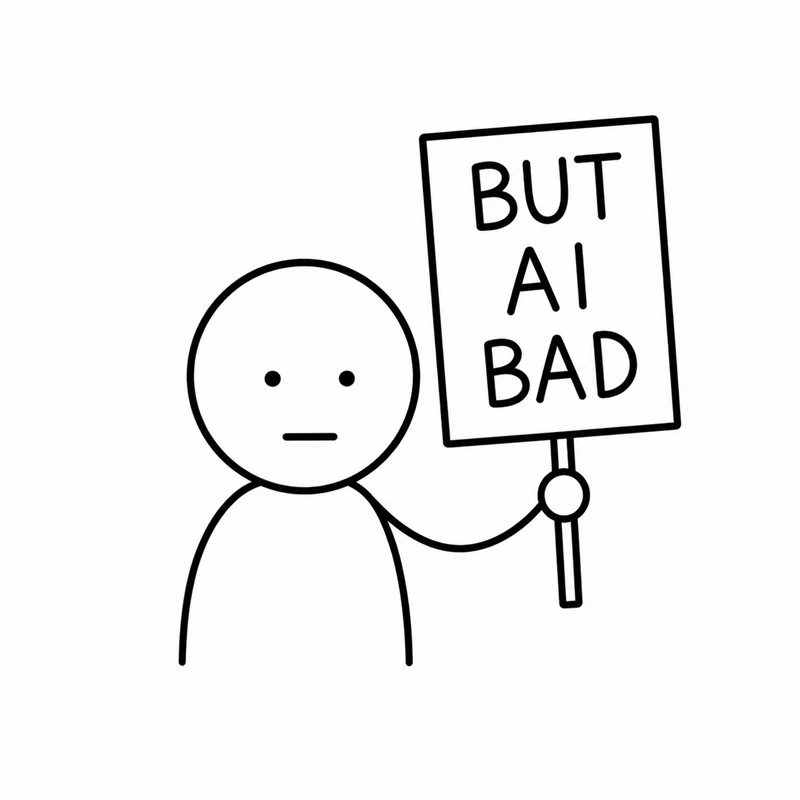
"AI is biased, so humans are better."
What this page actually tests
AI systems can produce materially biased outcomes and can scale or worsen discrimination relative to the human or institutional process they replace.
Wording note: Humans are better is a separate comparison that must be measured for the actual decision. Human bias does not disprove AI bias, and AI bias does not prove that every human process performs better.
AI bias is real; automatic human superiority is not established.
Misleading. AI can reproduce and scale harmful bias, including measured subgroup disparities. That does not establish that humans are generally better; the relevant comparison depends on the actual system, existing process, affected groups, and available recourse.
Why people repeat it
The concern is common because automated systems learn from historical data, can perform differently across demographic groups, and can apply the same hidden error pattern across many decisions.
What the sources support
Fact: NIST identifies three major bias categories in AI contexts: systemic bias, computational and statistical bias, and human-cognitive bias.
Baseline: Human institutions already contain systemic and cognitive bias; AI can inherit or amplify those patterns rather than inventing bias from nowhere.
Evidence conclusion: The evidence proves AI bias is real and multi-source. It does not prove humans are automatically the fairer fallback.
Source: Artificial Intelligence Risk Management Framework (AI RMF 1.0)
Fact: NIST warns AI can increase the speed and scale of biased outcomes even when discriminatory intent is absent.
Baseline: Manual workflows may be slower, but they can still be biased, inconsistent, and hard to audit.
Evidence conclusion: The conclusive concern is scale and accountability: automated bias can spread faster, so measurement and governance matter.
Source: Artificial Intelligence Risk Management Framework (AI RMF 1.0)
Fact: NIST's generative AI profile lists harmful bias and representational harms alongside privacy, security, confabulation, and information-integrity risks.
Baseline: The comparison is managed risk versus unmanaged risk, not AI bad versus humans pure.
Evidence conclusion: The evidence supports audits, documentation, contestability, and measured comparisons against human workflows.
Source: Artificial Intelligence Risk Management Framework: Generative Artificial Intelligence Profile
Fact: Gender Shades evaluated 3 commercial gender-classification systems and found error rates up to 34.7% for darker-skinned females versus a maximum 0.8% error rate for lighter-skinned males.
Baseline: That is a subgroup performance metric, not a vibes complaint. It compares measured error rates across groups and shows why aggregate accuracy can hide harm.
Evidence conclusion: The evidence confirms AI bias can be concrete and measurable, while also showing why audits need cross-group metrics rather than blanket AI-versus-human slogans.
Source: Gender Shades
Fact: A field experiment sending nearly 5,000 equivalent resumes found applicants with white-sounding names received about 50% more callbacks than applicants with African-American-sounding names.
Baseline: That measured disparity came from ordinary employer screening before today's generative-AI systems, providing a human-process baseline rather than assuming the alternative is neutral.
Evidence conclusion: Human bias does not excuse algorithmic bias. It means the valid comparison is measured error and disparate impact for both the AI system and the workflow it replaces.
Source: Are Emily and Greg More Employable than Lakisha and Jamal?
Source balance
Checked both sides before calling it.
Supports the claim
- Artificial Intelligence Risk Management Framework (AI RMF 1.0) - NIST identifies systemic, computational/statistical, and human-cognitive bias in AI contexts.
- Artificial Intelligence Risk Management Framework: Generative Artificial Intelligence Profile - NIST lists harmful bias and representational harms as generative AI risks.
- Gender Shades - Commercial gender-classification systems had much higher error rates for darker-skinned females than lighter-skinned males.
Challenges or narrows it
- Are Emily and Greg More Employable than Lakisha and Jamal? A Field Experiment on Labor Market Discrimination - A human-run hiring baseline produced a large callback disparity before generative AI, so humans are not an automatically unbiased control group.
- Artificial Intelligence Risk Management Framework (AI RMF 1.0) - NIST frames bias as also systemic and human, not uniquely an AI property.
- Artificial Intelligence Risk Management Framework: Generative Artificial Intelligence Profile - The profile emphasizes evaluation and risk management rather than defaulting to human alternatives.
- Gender Shades - The paper demonstrates measurable auditing methods, which supports comparing systems against alternatives instead of relying on slogans.
Baseline context
- Are Emily and Greg More Employable than Lakisha and Jamal? A Field Experiment on Labor Market Discrimination - Provides a same-domain human hiring baseline for comparing discriminatory outcomes.
- Artificial Intelligence Risk Management Framework (AI RMF 1.0) - Provides human, systemic, and statistical bias baselines.
- Gender Shades - Provides concrete subgroup error-rate metrics for cross-checking bias claims.
Assessment: The claim is misleading. Harmful AI bias is documented, but the human-superiority conclusion is not generalizable; the evidence requires a deployment-specific comparison of subgroup outcomes, scale, monitoring, and recourse.
Where critics may still have a point
- AI can scale biased decisions faster than manual workflows.
- Opaque systems can make it harder for affected people to contest outcomes.
- Audits can be weak if the organization controls the data, metrics, or release of results.
AI bias is real; automatic human superiority is not established.
Government frameworks and measured subgroup disparities confirm that AI can encode and amplify harmful bias. Human and institutional decisions are also biased. A deployment should compare subgroup outcomes, scale, monitoring, and recourse directly instead of using either side's existence of bias to declare the other generally better.
Why this verdict: The sources confirm harmful AI bias but do not support the slogan's general comparison that humans are better. Existing human and institutional outcomes must be measured against the specific AI deployment.
Sources
-
Artificial Intelligence Risk Management Framework (AI RMF 1.0)
Used for: AI risk categories, trustworthiness framing, and governance baseline.
-
Artificial Intelligence Risk Management Framework: Generative Artificial Intelligence Profile
Used for: Generative AI bias, information integrity, and evaluation risks.
-
Gender Shades: Intersectional Accuracy Disparities in Commercial Gender Classification
Used for: Cross-checking abstract bias framing against measured subgroup error-rate disparities.
-
Are Emily and Greg More Employable than Lakisha and Jamal? A Field Experiment on Labor Market Discrimination
Used for: A measured human hiring-process baseline showing that the non-AI alternative can also produce substantial discriminatory outcomes.