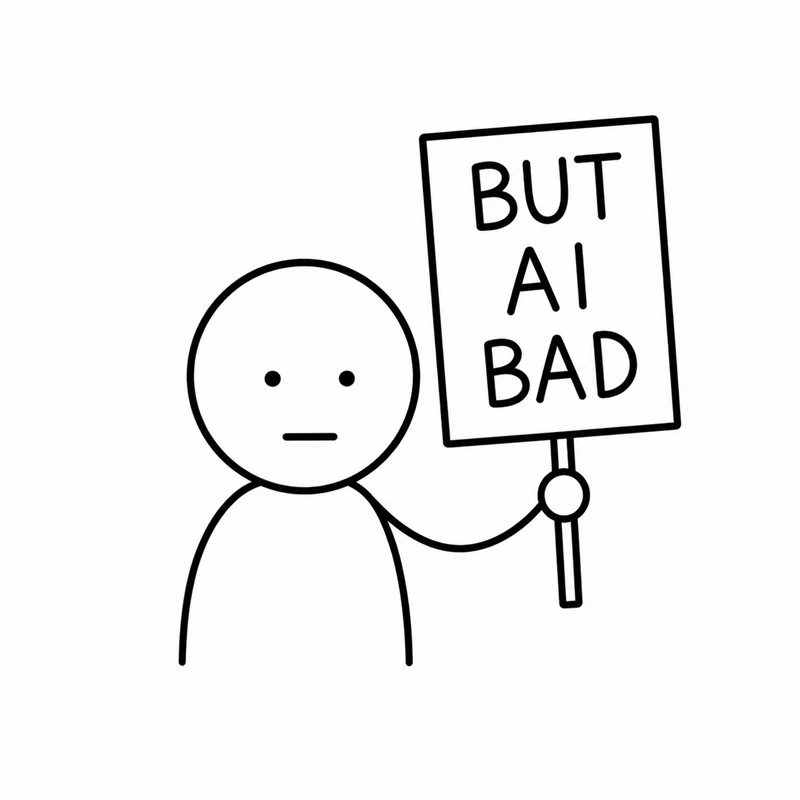
An em dash, polished tone, or neat formatting can be a clue. None can prove that AI wrote a specific text.
SourcedClaim rejectedem dash AI writingChatGPT hyphenAI writing tellshow to spot AI writingAI accusation punctuation
Common wording
"“That em dash proves ChatGPT wrote it.”"
What this page actually tests
A single stylistic clue, such as an em dash, neat formatting, a stock phrase, or an unusually polished tone, can establish that AI wrote a particular text.
Wording note: The slogan treats a possible pattern as conclusive authorship evidence. It also blurs AI-generated text, AI-assisted editing, human editing, and ordinary house style.
Quick verdict: Claim rejected
An em dash is a clue, not proof.
No. An em dash can be a clue worth noticing, especially beside several other changes in voice or structure. But one punctuation mark cannot prove who wrote a text or whether AI helped create it.
Why people repeat it
The rule is fast, memorable, and easy to apply in a comment section. It also responds to a real experience: some models have produced repetitive formatting and prose habits that readers now recognize.
Evidence
What the sources support
Fact: A 2026 preprint examining 69,632 medRxiv preprints found em dashes in Discussion sections rose from 4.23% before November 30, 2022 to 11.58% afterward.
Baseline: The same study found a 4.23% pre-ChatGPT baseline and explicitly said its result was a population-level indicator, not a detector for any individual paper.
Evidence conclusion: A shift in a large body of writing can make an em dash worth investigating. It does not show that any one writer used AI.
Fact: In a 2025 study of 300 English nonfiction articles, five frequent AI-writing users misclassified 1 article when judging human versus AI-generated work.
Baseline: Their explanations used several cues, including vocabulary, formality, originality, and clarity, rather than a single punctuation mark.
Evidence conclusion: People can sometimes spot broader patterns well. That is not evidence that an isolated em dash is a reliable test.
Fact: Authorship-attribution research describes lexical, syntactic, and structural markers. Punctuation is only one kind of syntactic marker.
Baseline: The same research uses known writing samples and many measured features, often including word-frequency patterns, to compare candidate authors.
Evidence conclusion: Real authorship analysis is comparative and multi-signal. A lone dash lacks the context needed for a defensible attribution.
Fact: Google’s editorial style guide instructs professional writers to use an em dash for a break or interruption in a sentence.
Baseline: NIH’s style guide likewise permits em dashes to set off nonessential information, much like commas or parentheses.
Evidence conclusion: The mark is ordinary, accepted human punctuation. Its presence cannot distinguish a human writer from an AI system.
Fact: A 2023 evaluation of 14 AI-text detection tools concluded that the tools tested were neither accurate nor reliable enough for dependable identification.
Baseline: Those tools used far more information than one punctuation mark, yet still struggled with false judgments and text changes.
Evidence conclusion: If full-text detectors need caution, a one-character accusation deserves even more caution.
Source balance
Checked both sides before calling it.
Supports the claim
Em-ergence of the em-dash: a population-level rise in em-dash frequency in medRxiv preprints at the dawn of the large-language-model era - It found a marked post-2022 rise in em-dash use in one scientific-preprint corpus, supporting the narrower idea that AI-era writing patterns may be measurable at population scale.
People who frequently use ChatGPT for writing tasks are accurate and robust detectors of AI-generated text - It found that experienced human readers could identify AI-generated articles well in its test set, supporting the idea that AI text can leave recognizable multi-part patterns.
Challenges or narrows it
Testing of Detection Tools for AI-Generated Text - Its evaluation of 14 tools concluded that available detectors were neither accurate nor reliable, undercutting casual certainty about authorship.
Dashes | Google developer documentation style guide - It treats the em dash as normal professional punctuation, so the character has a clear non-AI explanation.
Baseline context
Automated Authorship Attribution Using Advanced Signal Classification Techniques - It describes attribution as analysis across lexical, syntactic, and structural features, using known samples rather than a single visible tell.
Grammar and Punctuation | NIH Style Guide - It shows that em dashes are accepted in ordinary institutional writing and can serve the same job as commas or parentheses.
Assessment: AI systems can show recurring style patterns, and readers may correctly notice them. But the strongest available evidence supports multi-cue comparison, not punctuation-based proof. The em dash is also a standard human writing choice, so it cannot establish AI use by itself.
Visual evidence
The comparison behind the verdict.
Direct comparison
Em-dash use rose in one preprint corpus
Share of medRxiv preprint Discussion sections containing at least one em dash before and after ChatGPT’s public release.
What this shows: The increase is evidence of a corpus-level change, not proof about the author of any individual paper.
Unit: percent of Discussion sections with at least one em dash
Before November 30, 2022
4.23 percent of Discussion sections with at least one em dash
After November 30, 2022
11.58 percent of Discussion sections with at least one em dash
Source: Em-ergence of the em-dash: a population-level rise in em-dash frequency in medRxiv preprints at the dawn of the large-language-model era
Preprint research. The author states that the observational design cannot establish causation or identify AI use in a specific paper.
Where critics may still have a point
A sudden cluster of em dashes, generic transitions, stock praise, and unexplained changes from a person’s established voice can justify asking questions.
AI-assisted editing can make a human draft sound more polished, but that does not reveal how much of the final text came from the writer.
Draft histories and metadata can be incomplete or altered. They are stronger than punctuation, not automatic proof either.
Final verdict: Claim rejected
An em dash is a clue, not proof.
Do not treat an em dash, a tidy list, or a polished paragraph as a verdict. For a low-stakes guess, several unusual patterns may justify skepticism. For a consequential accusation, look for provenance: draft history, version records, a mismatch with known writing, workflow context, or direct disclosure. Even then, separate “AI may have helped” from “AI wrote this.”
Why this verdict: The claim fails its own proof standard. Evidence supports the narrower point that models and AI-assisted writing can show patterns, but accepted human writing uses the same punctuation and reliable attribution requires broader context.
Em-ergence of the em-dash: a population-level rise in em-dash frequency in medRxiv preprints at the dawn of the large-language-model erapaper - Jun 28, 2026
Used for: Measured the change in em-dash prevalence across 69,632 medRxiv preprints and directly cautioned that the result is not a per-paper AI detector.